
Biodegradable Mycelium Packaging in 2026: Production, Strength and Composting
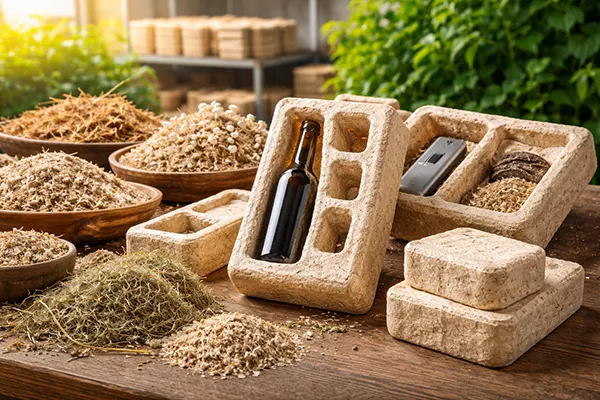
Mycelium packaging sits in an interesting middle ground: it is not a thin film like a compostable bag, and it is not a rigid plastic. It is a grown biocomposite, where fungal mycelium binds plant residues into a lightweight, moulded shape. In 2026 it is most commonly used as a substitute for expanded polystyrene (EPS) inserts and protective blocks, because the material’s best strengths match what “foam” packaging is supposed to do: cushion impacts, hold shape, and disappear safely at end of life when managed correctly.
How mycelium packaging is produced at commercial scale
Most production lines begin with a low-value feedstock: agricultural by-products such as hemp hurd, husks, straw, or sawdust. The feedstock is screened to a target particle size, then pasteurised or sterilised to reduce unwanted microbes. That step matters because contamination competes with the fungal culture, changes growth, and makes batches inconsistent. The goal is not “perfectly clean” in an academic sense, but stable, repeatable growth with predictable density.
After preparation, the substrate is inoculated with a selected fungal strain (often species known for fast, dense mycelial networks). The inoculated mix is placed into moulds that define the final geometry. During the growth phase, temperature, humidity and oxygen availability are controlled because they drive how quickly the mycelium colonises the substrate and how tightly it binds the particles. The “grown” part is not marketing language: the material properties are literally formed during this biological step.
Once the mould is fully colonised, the part is dried and heat-treated to stop further growth and lock the structure. Drying is also where dimensional stability is decided: too fast and parts can warp or crack; too slow and you risk uneven moisture and weaker zones. In 2026, the best manufacturers treat drying as a quality step, not a final afterthought, because it influences weight, stiffness and repeatability as much as the growth stage.
Material choices that decide density, feel and cost
Two packages made from mycelium can behave very differently because “mycelium composite” is a category, not a single recipe. Particle size, fibre content, and the ratio of substrate to mycelium all change density. Higher density generally brings higher compressive strength and better edge definition, but it also increases weight and can reduce the springy cushioning that protective packaging needs.
Growth time is another hidden lever. Short cycles are cheaper, but incomplete colonisation leaves weak points where the substrate is not fully bound. Longer cycles can improve cohesion, yet there is a point of diminishing returns where additional growth adds little mechanical gain. Good producers aim for a target density range that matches the use case: corner protectors, bottle shippers, electronics inserts, or larger blocks.
Finally, surface treatments matter. Many applications need basic moisture resistance, because mycelium composites are hygroscopic. In practice, manufacturers may add thin bio-based coatings, paper wraps, or design features that keep the product away from direct water. The trade-off is straightforward: the more barrier you add, the more you must think about composting conditions and local rules for “compostable” claims.
Strength, cushioning and real-world performance
Mycelium packaging is often compared to EPS, but the comparison only makes sense if you look at function. EPS is lightweight and resilient; mycelium composites can be similarly light and can cushion impacts well, especially when the design uses ribs, pockets, or crush zones. Where mycelium can struggle is uniformity: natural feedstocks vary, and small process shifts can change density, which then changes stiffness and failure behaviour.
Laboratory data across mycelium biocomposites shows wide ranges for mechanical properties because substrates and strains differ. In general, higher density samples show improved tensile and flexural performance, while low-density parts behave more like crushable foams. For packaging, compressive behaviour and energy absorption are usually more important than high tensile strength, which is why mould design and density control tend to matter more than chasing a single headline number.
Moisture is the most common practical weakness. If a part absorbs water, stiffness drops and dimensional stability can change. That does not automatically rule it out—EPS also has limits—but it means mycelium packaging needs sensible boundaries: it is excellent for dry supply chains and short exposure risks, and less suitable where parts sit in wet environments or must handle condensation for long periods.
How strength is tested and what buyers should ask for
For protective packaging, the key question is not “Is it strong?” but “Does it protect the product at the required drop heights and vibration conditions?” Responsible suppliers run compression tests, drop tests with real payloads, and ageing tests that include humidity cycles. A reliable spec should state density, moisture content at shipment, and acceptable tolerances, because those variables explain most surprises in performance.
It also helps to separate “biomaterial sheets” from “packaging blocks”. Companies making mycelium-based sheets for fashion or interiors may publish durability metrics relevant to abrasion and tear, while packaging suppliers focus on cushioning and compressive recovery. In procurement, mixing those categories leads to wrong expectations. The same organism can produce very different materials depending on the process.
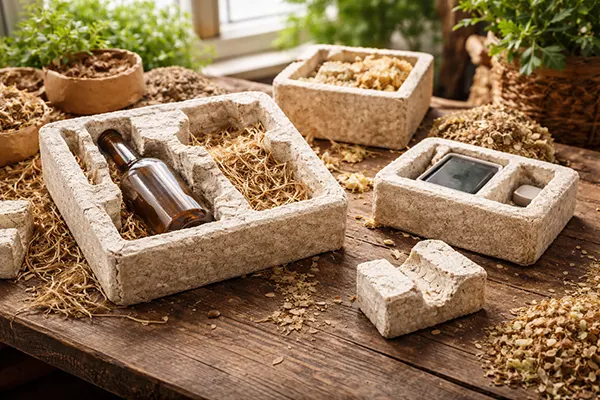
If you are evaluating mycelium packaging as an EPS replacement, ask for evidence from the exact geometry you will use, not from a generic sample puck. With foams and foamy biocomposites, shape is part of the material. A well-designed mycelium insert can outperform a poorly designed foam insert, even if the foam has better “material” numbers on paper.
Composting and end-of-life: what actually works in 2026
Mycelium packaging is commonly described as compostable, but the practical result depends on where it goes. In industrial composting, controlled heat, moisture and aeration speed up biodegradation and disintegration. In home composting, conditions are colder and less consistent, so timelines are longer and success varies by pile management. A product can be “biodegradable” in principle but still behave poorly if the compost system is not suitable.
Some suppliers explicitly claim home compostability for their mycelium packaging products. Even then, the safest guidance is to treat home composting like a process: break the packaging into smaller pieces, keep it mixed with “greens” and “browns”, and maintain moisture and aeration. Large, dense blocks in a cold, dry heap can sit for months longer than people expect, not because the material is fake, but because biology is slow at low temperatures.
Disposal messaging is becoming more regulated in Europe. From a 2026 perspective, compostability claims increasingly need to align with recognised standards and local infrastructure. The simple rule for users is: if your area does not accept compostable packaging in organic waste, “compostable” on the label does not create a collection route by itself.
Standards, labels and the EU context in 2026
In Europe and the UK, the reference point for industrial compostability claims is typically EN 13432-style assessment: biodegradation, disintegration, ecotoxicity and limits for metals and residues. Certification bodies and logos matter because they signal third-party testing rather than self-declared claims. Where a supplier cannot show a relevant certificate, it becomes difficult to separate real performance from optimistic marketing.
In the United States, the comparable route for compostable plastics is ASTM D6400, often paired with third-party verification schemes. Even though mycelium packaging is not “plastic”, the lesson transfers: buyers should expect documentation, not slogans. If a product includes coatings or adhesives, the full assembled item must be evaluated, not just the mycelium core.
Finally, EU rules on packaging and packaging waste applying from 2026 reinforce a broader shift: packaging must be designed with end-of-life in mind, and compostable packaging is treated as a specific category tied to standards and infrastructure. In practice, this pushes mycelium packaging toward its best-fit uses—protective, moulded applications with minimal extra layers—where composting or organic recovery can be credible rather than theoretical.