
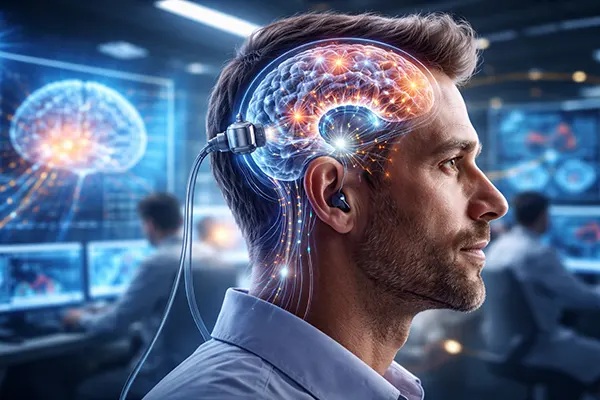
Brain Implant That Speaks Thoughts in Near Real Time: A New Stage of Neurointerfaces
Advances in neurotechnology have moved rapidly during the last decade, but several breakthroughs announced between 2023 and 2026 have brought brain–computer interfaces much closer to practical medical use. Scientists have demonstrated implants capable of converting neural activity into spoken words almost instantly. These systems analyse signals from the brain areas responsible for speech and translate them into synthetic voice output. For people who have lost the ability to speak due to paralysis, stroke or neurodegenerative disease, such technology may restore a fundamental form of communication.
How modern brain implants translate neural signals into speech
Brain implants designed for speech decoding operate by recording electrical activity directly from the cerebral cortex. Electrodes placed on or inside the brain detect patterns produced when a person attempts to speak or internally formulates words. These patterns are processed by machine-learning algorithms trained to recognise neural signatures associated with phonemes, syllables and full words. Over time, the system becomes capable of predicting intended speech with increasing accuracy.
Several research teams have demonstrated real-time decoding of speech signals from the brain. In 2023, scientists from the University of California San Francisco presented a neural interface that could convert attempted speech into text at speeds approaching natural conversation. The device recorded activity from the speech motor cortex and translated signals using artificial intelligence models trained on thousands of recorded neural patterns.
By 2025 and early 2026, improvements in electrode density, signal processing and AI language models enabled faster and more natural voice synthesis. Instead of producing text, some experimental systems now generate audible speech that resembles the user’s own voice. Researchers achieve this by combining neural decoding with voice reconstruction models trained on recordings made before the patient lost speech.
Why the brain’s speech cortex is the key target for these devices
The human brain contains specialised regions responsible for planning and producing speech. Two of the most important areas are Broca’s area, involved in speech production, and the motor cortex that controls the muscles used for articulation. When a person prepares to speak, these regions generate distinctive electrical patterns that can be measured by implanted electrodes.
Even when speech muscles are paralysed, the brain often continues to generate the same signals that would normally drive vocalisation. This is why patients with conditions such as ALS or brainstem stroke may retain intact neural speech commands. Brain–computer interfaces can intercept these signals before they reach damaged motor pathways and translate them into digital output.
Understanding these neural pathways has been possible thanks to decades of neuroscience research and clinical brain mapping. Modern implants build on this knowledge by combining neural recording technology with machine learning models capable of recognising extremely subtle patterns in brain activity.
Recent scientific breakthroughs between 2023 and 2026
Several landmark experiments have demonstrated the practical potential of neural speech implants. In 2023, researchers reported a system that could decode around 60 to 70 words per minute from brain signals. While this was slower than natural speech, it represented a dramatic improvement over earlier communication devices that relied on eye tracking or letter-by-letter typing.
Another breakthrough occurred when scientists developed models capable of reconstructing speech directly as sound. Instead of generating text that must later be spoken by software, the implant produces a voice output immediately. Early demonstrations showed that the reconstructed voice could even carry emotional tone based on neural patterns associated with prosody.
Commercial research initiatives have also accelerated progress. Companies working on brain–computer interfaces have begun testing high-channel implants capable of recording thousands of neural signals simultaneously. Higher signal resolution allows algorithms to decode speech intentions more accurately and reduce delays between thought and audio output.
Medical applications for patients who cannot speak
The most immediate use of these implants is in clinical rehabilitation. Patients with amyotrophic lateral sclerosis, spinal cord injuries or severe stroke often lose the ability to control muscles required for speech. Traditional assistive technologies allow communication but remain slow and exhausting for users.
Neural speech implants may restore more natural conversation. Instead of selecting letters or words manually, the patient simply attempts to speak. The implant interprets the brain signals and produces speech through a computer or external speaker. Early studies suggest that patients can learn to use these systems within weeks.
For individuals who have been unable to communicate verbally for years, the psychological impact could be significant. Restoring direct expression of thoughts may improve autonomy, social interaction and overall quality of life. Medical researchers therefore consider speech neurointerfaces one of the most promising therapeutic applications of brain–computer technology.
Technical challenges and ethical questions surrounding neurointerfaces
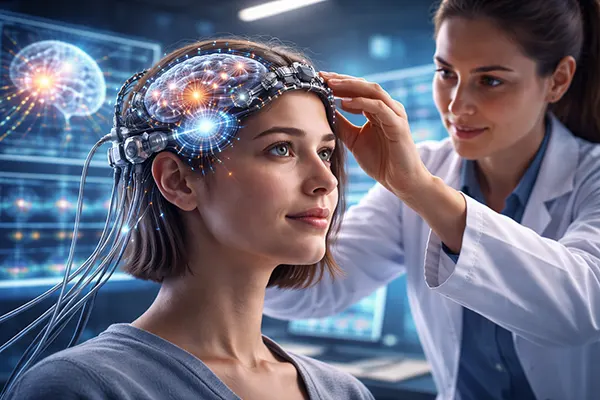
Despite impressive progress, brain implants capable of reading speech intentions remain experimental medical devices. One of the major challenges involves long-term stability of implanted electrodes. Over time, biological reactions around the implant can reduce signal quality, requiring improvements in materials and surgical techniques.
Another challenge is decoding accuracy. Human language is extremely complex, and neural signals vary between individuals. Algorithms must be trained specifically for each patient using extensive calibration sessions. Researchers are exploring large neural datasets and advanced AI models to reduce training time and improve generalisation.
There are also practical concerns regarding device size, energy consumption and wireless data transmission. For real-world use, implants must operate safely inside the body for many years without frequent surgical replacement. Engineers are therefore developing low-power electronics and fully implantable systems.
Future outlook for brain–computer communication
Looking ahead to the late 2020s, neuroscientists expect rapid improvements in neural decoding accuracy and speed. Advances in artificial intelligence, particularly large language models adapted for neural signals, may help interpret incomplete or noisy brain data more effectively. This could allow systems to predict intended words even when neural patterns are partially ambiguous.
Researchers are also investigating less invasive recording techniques. Instead of penetrating the brain tissue, some devices place flexible electrode arrays on the surface of the cortex. These systems may reduce surgical risks while still providing sufficiently detailed neural signals for speech decoding.
If these developments continue, brain–computer communication may expand beyond medical rehabilitation. In the longer term, neural interfaces could enable direct interaction between human thought and digital systems. For now, however, the most important goal remains restoring the basic human ability to communicate for people who have lost their voice.