

Perovskite-Silicon Solar Cells: Is Tandem Technology Ready for Mass Production?
Perovskite-silicon tandem solar cells have spent much of the past decade being described as the technology that could take photovoltaic efficiency beyond the practical limits of conventional silicon. By 2026, that promise is no longer based only on small laboratory samples. Certified tandem-cell efficiencies have moved above 35%, industrial-size cells are passing the 30% mark, commercial modules have been shipped to customers, automated pilot lines are operating and established solar manufacturers are preparing substantially larger production capacity. Yet there is an important distinction between proving that a tandem module can be manufactured and producing it at the enormous scale, consistency and cost achieved by today’s silicon industry. Perovskite-silicon technology has therefore reached an unusual stage: it is commercially real, but it is not yet a mainstream commodity product. Its efficiency advantage is increasingly clear, while durability, production yield, long-term warranties, environmental controls and manufacturing economics still have to be demonstrated across millions of modules rather than hundreds or thousands. The question in 2026 is no longer whether tandem solar cells can work. It is whether manufacturers can make them repeatedly, cheaply and reliably enough to compete with an exceptionally mature silicon supply chain.
Why Perovskite-Silicon Tandems Have Moved Beyond the Laboratory
The reason for combining perovskite and silicon is relatively straightforward. A conventional silicon cell uses one semiconductor to convert sunlight into electricity, but no single semiconductor can use every part of the solar spectrum equally efficiently. High-energy photons lose some of their energy as heat, while lower-energy photons may not be absorbed at all. A tandem device divides the task between two cells. The thin perovskite top cell absorbs higher-energy visible light, while the silicon cell beneath it uses much of the lower-energy light that passes through. This allows more of the incoming solar energy to become electricity without requiring a larger panel. Fraunhofer ISE puts the theoretical efficiency limit of a conventional crystalline-silicon cell at about 29.4%, while a suitable perovskite-silicon tandem can in principle approach 43.3%. That does not mean commercial products will reach 43%, but it explains why manufacturers are interested in adding another active layer rather than spending increasingly large sums to extract very small improvements from silicon alone.
Progress in actual devices has been unusually fast. In July 2026, LONGi announced a certified 35.5% conversion efficiency for a crystalline-silicon/perovskite tandem cell, verified by the European Solar Test Installation. The significance of the wider development programme is not limited to a small record cell. LONGi has also reported 34.3% efficiency on a 261 cm² device and 32.2% on a 274 cm² device, dimensions much closer to the wafers used by modern solar factories. Its reported tandem-module results have reached 31.4% and 29.4% in separately certified configurations. Large-area performance matters because a process that works on a carefully prepared laboratory sample may behave very differently when the coating has to remain uniform across a full industrial wafer. Moving above 30% on large devices is therefore a more relevant manufacturing signal than simply raising the absolute laboratory record by another fraction of a percentage point.
Commercial activity has also begun. Oxford PV announced the first commercial shipment of perovskite-on-silicon tandem modules in September 2024, sending 72-cell panels to a US customer for a utility-scale installation. Those initial market modules were rated at 24.5% efficiency and used tandem cells produced in Brandenburg an der Havel, Germany. Oxford PV had already demonstrated a 26.9%-efficient 60-cell residential-size tandem module certified by Fraunhofer CalLab. By June 2026, the company and Fraunhofer ISE had also presented shingled tandem modules with full-area efficiency of 25.6%: a 491 W rooftop module measuring 1.92 m² and a 546 W bifacial module measuring 2.13 m². These are recognisable solar products rather than tiny research cells. They show that tandem technology can survive cell cutting, electrical interconnection, encapsulation and final module assembly while retaining a meaningful efficiency advantage.
What the 2026 Efficiency Numbers Actually Mean
Efficiency records need to be interpreted carefully because cell efficiency, module efficiency and factory-average efficiency are different measures. A record cell is produced under tightly controlled conditions and may represent the best sample from a research run. A module contains many interconnected cells as well as glass, encapsulants, wiring and inactive spaces, so its percentage is normally lower. Factory output introduces another requirement: hundreds or thousands of devices must remain within a narrow performance range. A 35.5% record therefore should not be read as evidence that 35.5%-efficient rooftop panels are ready for immediate mass delivery. The more useful pattern is that laboratory records, commercial-size cells and complete modules are all advancing at the same time. That narrowing gap suggests the technology is becoming more manufacturable rather than simply producing isolated scientific records.
Qcells provides another useful example of this distinction. Its perovskite-silicon tandem work produced a certified 28.6%-efficient cell on a full M10-size industrial silicon wafer of about 330 cm². The cell came from the company’s German R&D pilot line and was made with processes intended to be compatible with industrial production. The percentage is lower than the latest small-device records, but the format is much more relevant to a future factory. In July 2026, Qcells also announced TÜV Rheinland certification confirming that its tandem modules had met applicable IEC and UL durability and safety requirements, including testing designed for multi-junction modules. Certification does not guarantee that a module will operate for 30 years, but it is an essential step between laboratory performance and a product that project developers, insurers and financiers can seriously evaluate.
Another important benchmark is comparison with silicon rather than comparison between tandem research teams. Silicon technology is still improving. LONGi reported a 26.4%-efficient crystalline-silicon module in 2026, showing that tandem products are competing with a moving target. For a new architecture to justify additional production stages, it must offer more than a modest laboratory advantage. The gain must survive manufacturing losses, packaging and years outdoors. The encouraging sign is that tandem modules in the mid-20% range are already being built while development devices have moved substantially higher. If production modules can progress towards 27%, 28% and eventually 30% without unacceptable cost or degradation, the benefit becomes significant for rooftops, solar farms and other applications where every square metre has a measurable economic value.
What Still Stands Between Pilot Lines and Mass Manufacturing
The main manufacturing difficulty is producing an extremely thin and uniform perovskite layer over a large silicon cell at high speed. Laboratory researchers can use techniques that are excellent for experiments but unsuitable for a factory producing thousands of wafers per hour. Industrial production needs coating or deposition methods that use materials efficiently, control thickness across the entire wafer and work consistently despite small variations in temperature, humidity, surface texture and incoming silicon cells. Progress is visible here as well. Fraunhofer ISE and KAUST demonstrated a scalable route using evaporation and blade coating in 2025, achieving tandem efficiencies close to 28% while replacing laboratory spin coating with a technique more appropriate for large areas. In 2026, other researchers reported close-space sublimation as a solvent-free method suited to high-throughput deposition. None of these methods has automatically won the manufacturing race, but they show that the industry’s attention has shifted from whether high-quality perovskite films are possible to how they can be made rapidly and repeatedly.
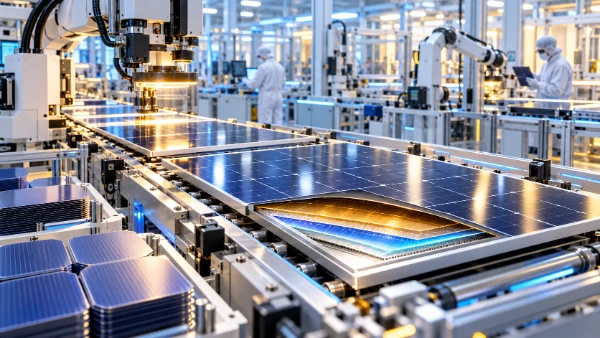
Pilot-line activity in 2026 makes the scale-up picture more concrete. Tongwei says it commissioned a fully automated 5 MW perovskite-silicon tandem pilot line in September 2025. By August 2026, the company reported more than 32.68% efficiency on a commercial-size tandem cell, a 776 W module in its 210-66 format and monthly average pilot-line cell efficiency above 28%. The monthly figure is particularly relevant because it reflects repeated production rather than a single champion device. Tongwei is working towards a larger 100 MW pilot stage. LONGi, meanwhile, has outlined plans for its own 100 MW tandem pilot line. Fraunhofer ISE opened its Pero-Si-SCALE laboratory in May 2026 to help manufacturers transfer tandem designs to wafers as large as 210 × 210 mm using industrially relevant equipment. These developments indicate that the next step is no longer a jump directly from a university laboratory to a multi-gigawatt factory; manufacturers are deliberately inserting intermediate production stages where yield, throughput and process control can be measured.
That intermediate stage is essential because today’s silicon industry operates at a scale that is difficult for any new technology to match. Modern silicon cells and modules are produced in enormous volumes using factories that have been refined over many technology generations. Equipment is available from numerous suppliers, raw-material flows are established, automation is highly developed and every production step has known tolerances. A tandem manufacturer adds new materials and deposition stages while still relying on much of the existing silicon process. The additional efficiency therefore has to compensate for additional equipment, slower throughput if it occurs, more complex quality control and any reduction in production yield. A tandem cell that is spectacular when it works but requires too many defective units to be discarded will not be competitive. In this part of the transition, percentage yield on the factory floor may ultimately matter more than another laboratory efficiency record.
Durability, Lead and Real-World Reliability
Long-term stability remains the issue most frequently associated with perovskites. Silicon modules have decades of field data, whereas modern perovskite compositions have evolved so rapidly that comparable long-duration operating histories do not yet exist. Perovskite layers can be affected by moisture, oxygen, elevated temperature, ultraviolet exposure and prolonged illumination. Ions inside the material can move under electrical or thermal stress, and some wide-bandgap compositions can undergo changes that reduce performance. Partial shading creates another problem because shaded cells can experience reverse electrical bias. A 2026 Nature Energy study specifically addressed this type of stress and demonstrated tandem cells that retained more than 92% of their initial efficiency after 1,000 hours at substantial reverse bias, while a larger multicell string kept more than 90% after 1,000 hours of shading-related testing. That is meaningful progress, but 1,000 hours of controlled testing is still different from decades of changing weather on a roof or solar farm.
Encapsulation is consequently just as important as the active cell. The perovskite layer does not have to survive outdoors unprotected: it sits inside a sealed module containing glass, encapsulants and edge barriers designed to keep water and oxygen away from sensitive materials. Double-glass structures and improved edge seals are already being used in tandem designs. Qcells’ 2026 certification is significant because the company’s modules passed recognised sequences covering environmental stress and electrical safety rather than being assessed solely for initial efficiency. Oxford PV and Fraunhofer have likewise used glass-glass construction and edge sealing in their 2026 shingled tandem modules. However, standard qualification tests are designed to identify weak products within a reasonable testing period. They cannot reproduce every combination of climate, installation error, shading, mechanical stress and ageing that can occur during a 25- or 30-year operating life. Manufacturers will still need extensive outdoor data and conservative warranty evidence.
Most high-efficiency perovskite compositions also contain a small quantity of lead, which creates a separate environmental requirement. The issue is not that tandem panels use enormous amounts of lead; the active perovskite layer is extremely thin. The concern is what happens if a module is badly damaged, exposed to water or discarded without appropriate recycling. A 2026 review in Nature Energy identified lead management as an important condition for safe commercialisation and examined methods that trap lead compounds inside damaged modules, as well as recycling and closed-loop material recovery. Effective encapsulation can reduce the probability of leakage, while dedicated lead-binding layers can reduce the quantity released if a module breaks. For mass production, however, these protections need to be inexpensive, durable and compatible with recycling. Manufacturers will also have to satisfy national chemical, waste and product-safety requirements, meaning environmental design cannot simply be postponed until after the electrical performance is solved.
Where Tandem Solar Is Most Likely to Reach Scale First
The first strong markets for tandem modules are likely to be applications where available surface area is expensive or strictly limited. A house with a small roof, a commercial building with high electricity demand, a constrained utility site or a solar installation where land and balance-of-system costs are high can benefit disproportionately from additional watts per square metre. If two modules occupy the same area but one generates materially more electricity, the project may need fewer mounting structures, cables and other components for a given capacity, or it may simply fit more generating capacity on the site. This is why early tandem products do not necessarily have to match the cheapest silicon module on price per panel. They need to offer attractive economics for the complete installation. Oxford PV’s early focus on utility, premium rooftop and specialist applications follows this logic: high efficiency has the greatest immediate value where space, weight or installation cost limits the project.
Tandem technology also has an advantage because it does not require the solar industry to abandon silicon. The most commercially advanced designs place a perovskite top cell onto an existing crystalline-silicon bottom cell, allowing manufacturers to build on decades of silicon development. Companies are therefore working to make new deposition stages compatible with familiar wafer sizes, module formats and production equipment. The European PEPPERONI project, coordinated by Qcells, was created specifically to develop industrial perovskite-silicon manufacturing, demonstrate efficient modules at production-relevant scale and improve operational stability towards the lifetime expected by the market. Its longer-term objective points towards gigawatt-capable production before 2030. That timescale is revealing. Even organisations already operating tandem pilot lines do not treat the transition from megawatts to gigawatts as automatic; equipment, process speed, yield and reliability all have to mature together.
The competitive environment may accelerate that transition. Oxford PV has already shipped commercial tandem products, Qcells has moved into standards-based certification, Tongwei is operating an automated pilot line, LONGi is preparing larger-scale production work and other major manufacturers are pursuing their own tandem programmes. This means the technology is no longer dependent on a single company successfully creating an entirely new supply chain. Equipment suppliers, research institutes and established cell manufacturers are working on different deposition and device approaches at the same time. Competition can reduce equipment costs and establish common manufacturing practices, but it can also reveal which concepts are economically weak. During the next stage, the strongest evidence will come from repeatable factory output: stable monthly efficiency, high production yield, low degradation rates and modules sold with warranties that developers and insurers are willing to accept. Those indicators will say more about commercial maturity than the number of efficiency announcements alone.
A Realistic 2026 Verdict for Manufacturers and Solar Buyers
As of 2026, perovskite-silicon tandem technology can reasonably be described as ready for early commercial manufacturing, but not yet ready to replace conventional silicon across mass-market solar production. The distinction matters. Real modules have been produced and sold, industrial-size cells have reached high efficiencies, automated pilot lines exist and internationally recognised qualification tests have been passed. These are achievements that place the technology well beyond the experimental stage. At the same time, most tandem manufacturing capacity remains tiny beside established silicon factories, and several leading companies are still building 5 MW or 100 MW pilot facilities rather than multi-gigawatt production lines. The technical case has become strong; the industrial case is still being proven. In other words, tandem solar no longer needs to demonstrate that it can become a product. It needs to demonstrate that the product can be manufactured in enormous quantities with predictable quality and financeable long-term performance.
For solar buyers, that means tandem modules should be judged as an emerging premium option rather than an automatic replacement for every silicon panel. Projects with limited roof or land area can benefit sooner because higher efficiency creates direct value. Early utility installations can also provide the operating data manufacturers need. Buyers considering such products should pay close attention to independently measured module efficiency, recognised safety and durability certification, warranty terms, the manufacturer’s actual production capacity and evidence from outdoor operation. A cell-efficiency record on its own is not enough. The most credible products will combine strong module-level performance with transparent test results and a company capable of supporting a warranty for decades. This is especially important during the first years of commercial deployment, when manufacturing methods and material formulations are still changing faster than they do in mature silicon production.
For manufacturers, the next few years are likely to decide how quickly tandem solar moves into the mainstream. The scientific ceiling is high enough to justify the effort, and efficiency is no longer the principal uncertainty. The priority is now repeatability: uniform coating on full-size wafers, high factory yield, fast processing, stable encapsulation, controlled lead management and dependable operation through heat, humidity, ultraviolet exposure and partial shading. If 100 MW pilot lines can demonstrate these qualities and expand into gigawatt factories without losing the efficiency advantage, perovskite-silicon tandems could become an important commercial solar technology before the end of the decade. If lifetime or production costs remain problematic, adoption may stay concentrated in premium and space-constrained applications for longer. The evidence available in 2026 therefore supports cautious confidence rather than claims of an immediate industry-wide replacement: mass production has started at its earliest stages, while true high-volume maturity is still the next milestone.