
Micro Drones with Artificial Whiskers: How TU Delft Enables Navigation Without Cameras
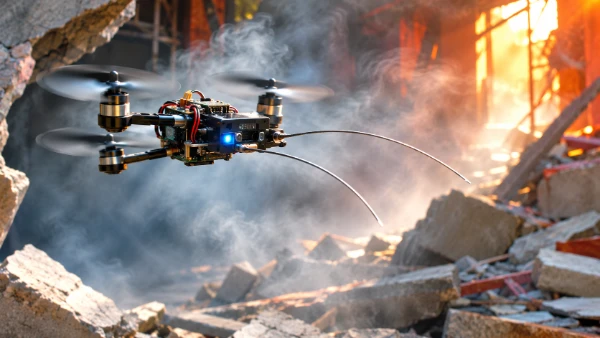
Imagine a tiny drone entering a smoke-filled building where cameras cannot see, GPS signals are unavailable and conventional navigation sensors struggle to detect nearby obstacles. Researchers at Delft University of Technology (TU Delft) in the Netherlands have developed an unusual solution: artificial whiskers that allow flying robots to sense their surroundings through physical contact. Inspired by rats and other whiskered animals, this lightweight technology enables micro drones to follow walls, identify obstacles and explore unfamiliar spaces without relying on vision. Published in Nature Communications in September 2026, the research introduces a new approach to autonomous flight that could eventually improve search-and-rescue operations, industrial inspections and robotic exploration in dangerous environments.
How TU Delft Developed Micro Drones That Navigate Through Touch
Most autonomous drones depend on cameras, laser scanners or distance-measuring sensors to understand their surroundings. These technologies work reasonably well when obstacles are visible and there is sufficient space to manoeuvre. However, a different situation emerges inside dark tunnels, damaged buildings or enclosed industrial facilities. Smoke and airborne dust can interfere with optical measurements, while transparent or reflective surfaces may confuse conventional sensors. Small drones face an additional difficulty: they cannot carry heavy equipment without sacrificing flight time, manoeuvrability or stability. Researchers at TU Delft therefore investigated whether physical touch could provide an alternative source of information when visual navigation becomes unreliable.
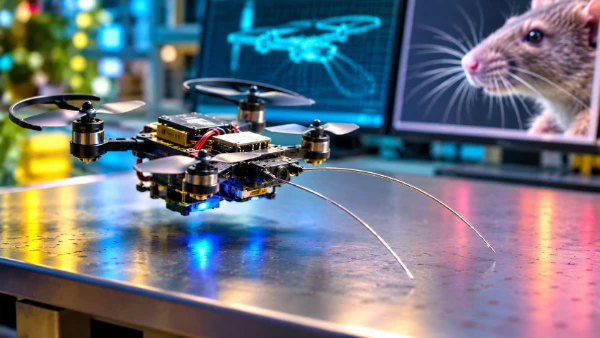
The project was developed by Chaoxiang Ye, Guido de Croon and Salua Hamaza from TU Delft’s Faculty of Aerospace Engineering. Their study, titled “Whisker-based tactile flight for tiny drones”, was published in Nature Communications on 18 September 2026. The researchers created a compact sensing system weighing approximately 3.2 grams, designed for small flying robots weighing less than 50 grams. Instead of depending on a camera to identify every nearby obstacle, the experimental drone uses two flexible artificial whiskers positioned at its front. These extensions detect contact with surrounding objects and help the aircraft determine how to move safely through confined spaces.
The underlying idea comes from the remarkable sensory abilities of rodents. Rats and mice routinely travel through dark burrows, narrow passages and cluttered environments using their whiskers to detect nearby surfaces. Their whiskers are not simply hairs: they are specialised sensory structures that transmit information about contact, movement and surrounding objects. TU Delft researchers adapted this biological principle for aerial robotics, creating a system that translates gentle mechanical contact into useful navigation information. The result is not a miniature copy of an animal’s nervous system, but an engineered alternative that makes a small flying robot less dependent on light and external positioning equipment.
Artificial Whiskers: The Lightweight Sensors Behind the Technology
Each artificial whisker consists of a thin, flexible wire made from Nitinol, a metal alloy commonly associated with medical devices and flexible mechanical components. In the TU Delft design, the wire measures approximately 20 centimetres in length and 0.4 millimetres in diameter. Its flexibility is essential because the whisker must bend when it touches an obstacle rather than transferring a strong impact directly to the drone. This allows the aircraft to gather information through relatively gentle contact. The whisker is connected to a specially designed base that converts bending movements into measurable changes, providing the drone with information about the position of nearby surfaces.
Three miniature pressure sensors are installed at the base of each whisker. Rather than directly measuring pressure in the surrounding air, these sensors detect tiny changes produced when the whisker bends against an object. By analysing the combined measurements, the onboard electronics can estimate the direction and depth of contact. The system effectively provides three-dimensional information about a surface without requiring a conventional depth camera. This is especially useful when a drone encounters objects that are difficult to recognise visually, including transparent partitions or obstacles in complete darkness. The researchers demonstrated that the sensing arrangement can provide contact-depth estimates with millimetre-scale accuracy.
Keeping the sensor lightweight was only part of the challenge. The drone’s propellers generate continuous airflow that can disturb the whiskers and produce signals resembling physical contact. Mechanical vibrations and gradual changes in sensor readings also complicate interpretation. To address these problems, the researchers developed software that distinguishes meaningful contact from unwanted disturbances. Remarkably, the complete tactile perception system operates using approximately 34 kilobytes of memory on the drone’s onboard controller. This efficiency matters because miniature aircraft have limited computing resources and batteries. The technology therefore combines mechanical simplicity with carefully designed processing rather than depending on powerful computers or a permanent connection to external equipment.
How Whisker-Equipped Drones Navigate in Darkness, Dust and Smoke
The most important feature of TU Delft’s approach is its independence from visual information. A conventional camera requires light or another suitable imaging method to identify obstacles, whereas a whisker detects contact regardless of whether the surrounding environment is illuminated. When the drone approaches a wall, the flexible sensor bends and sends measurements to its controller. The aircraft can then adjust its movement according to the detected surface. This approach is particularly relevant to environments where visibility cannot be guaranteed. Darkness does not prevent the whiskers from functioning, while smoke and dust do not interfere with their basic mechanical sensing principle in the same way they can affect optical systems.
The research demonstrates several different navigation behaviours rather than a single obstacle-detection function. In experiments, the drone followed the contours of rigid and soft surfaces, maintained contact with nearby walls and explored enclosed environments. It could also build a representation of its surroundings using information gathered through touch. These abilities were demonstrated without relying on cameras or external positioning infrastructure for the tactile navigation tasks. The findings are significant because contact-based navigation has traditionally been easier to implement on ground robots or larger flying machines. A miniature aircraft must remain airborne while sensing an obstacle, which introduces additional challenges involving balance, movement and reaction speed.
However, navigation through touch should not be confused with detecting everything at a distance. Artificial whiskers provide information when they physically encounter a surface, meaning that the drone must approach objects closely enough for contact to occur. Its knowledge of the environment is therefore built progressively as it moves. This differs from LiDAR or other distance sensors that can measure objects before reaching them. The technology also does not automatically solve every problem associated with flying through smoke or dust. Strong air currents, loose debris, damaged propellers and other environmental hazards remain important considerations. Its advantage lies in providing useful spatial information when visual measurements are unavailable or unreliable.
What the 2026 Experiments Revealed About Autonomous Flight
One of the most revealing demonstrations involved flying along surfaces in complete darkness. As the drone moved, its whiskers maintained contact with nearby objects and supplied continuous feedback for flight adjustments. The researchers tested the ability to follow different surface shapes, including materials that were not entirely rigid. This distinction matters because real environments contain more than smooth concrete walls. Curtains, soft partitions, uneven structures and other obstacles may respond differently to contact. The experiments showed that the system could adapt to variations in surface behaviour rather than functioning only against a single carefully prepared obstacle.
Another experiment examined exploration inside enclosed spaces. By following walls and interpreting successive contacts, the drone could develop a tactile representation of an unfamiliar environment and locate an exit. The process resembles how a person might find their way through a dark room by keeping one hand against a wall, although the drone uses automatic control and sensor measurements instead of human judgement. The researchers also demonstrated navigation around transparent obstacles that create difficulties for some vision-based methods. Together, these tests established that the whiskers could support more than basic collision detection: they could contribute directly to autonomous movement and environmental exploration.
The experiments also demonstrated how much information can be processed using extremely limited onboard resources. The flight controller employed an STM32F405 microcontroller with 192 kilobytes of RAM, while the research team’s tactile perception algorithms required only around 34 kilobytes. The software corrected sensor disturbances, estimated contact information and supported navigation decisions without depending on remote computing infrastructure. This is an important distinction for operations inside buildings, tunnels or other locations where wireless communication may be interrupted. Nevertheless, the published results describe controlled research demonstrations. They do not establish that the drone has already completed operational rescue missions inside burning buildings or reliably navigated every possible concentration of smoke and airborne dust.
Where Artificial Whisker Drones Could Be Used in the Future
Search-and-rescue operations represent one of the most promising potential applications. After a building collapse, explosion or fire, emergency personnel may need information about areas that are too dangerous or inaccessible to enter immediately. Small drones could potentially travel through openings that larger aircraft cannot reach, using their whiskers to recognise nearby walls and obstacles when visibility is poor. Such robots might help responders understand the arrangement of damaged corridors or investigate confined spaces before sending people inside. However, the TU Delft prototype is primarily a navigation research system, not a complete rescue drone equipped with thermal imaging, communication equipment or specialised victim-detection instruments.
Industrial inspection offers another possible direction. Maintenance teams regularly examine ventilation ducts, utility tunnels, enclosed machinery spaces and other locations where access is difficult. Conventional drones may struggle in narrow environments, particularly when surfaces are reflective, lighting is insufficient or there is little room to avoid obstacles. A lightweight tactile sensor could help a miniature inspection drone maintain a controlled distance from nearby structures through gentle contact. This may be useful when examining pipes, interior walls or confined passages. Such applications would still require additional equipment depending on the task, including suitable inspection sensors, protective components and reliable methods for recording findings.
Scientific exploration and environmental monitoring could also benefit from tactile navigation. Underground cavities, caves and other poorly illuminated locations present difficulties for robots that depend heavily on visual information. Small aircraft with artificial whiskers might eventually help examine these spaces while collecting measurements from additional instruments. The broader significance extends beyond drones: the research demonstrates that physical contact can provide a practical source of spatial information for autonomous machines with limited computing power. It could encourage designers to develop robots that combine cameras, distance sensors and tactile feedback, allowing different sensing methods to compensate for one another when environmental conditions change.
Current Limitations and the Next Steps for Whisker-Based Robotics
Despite the encouraging results, several limitations must be addressed before whisker-equipped micro drones become practical equipment for emergency services or industry. Contact-based sensing provides information only about surfaces within reach of the whiskers, leaving other parts of the surrounding environment less directly observed. Small flying robots also have limited battery capacity and payload allowance, so adding communication systems, inspection cameras or other instruments requires careful compromises. The sensors themselves must withstand repeated bending, accidental impacts and potentially abrasive surfaces. A system that performs reliably during laboratory experiments must also be tested under less predictable conditions involving moving obstacles, irregular structures and changing airflow.
Navigation in genuinely hazardous environments raises additional questions. Smoke-filled buildings may contain extreme temperatures, suspended particles and powerful air currents that threaten the aircraft independently of its navigation method. Dust can accumulate on mechanical components, while narrow passages may contain cables, loose materials or protrusions that could entangle the whiskers. The published research establishes the feasibility of tactile navigation, but it does not demonstrate comprehensive resistance to these hazards. Future development would need to examine long-term durability, operational reliability and recovery procedures if a drone becomes trapped or loses stable flight. For rescue applications, such testing would be essential before the technology could be trusted near people or critical infrastructure.
The most realistic long-term direction may involve combining artificial whiskers with other lightweight sensors rather than replacing every conventional navigation method. Cameras can provide detailed visual information when visibility is good, while tactile sensing remains useful when nearby surfaces cannot be seen reliably. Combining these abilities could give autonomous drones greater flexibility across different environments. As of November 2026, TU Delft’s work remains a research breakthrough rather than a commercially established navigation product. Nevertheless, the experiments have demonstrated something important: even a flying robot weighing only a few dozen grams can use touch to make navigation decisions, explore unfamiliar surroundings and operate without visual guidance. The artificial whisker may be a simple mechanical structure, but its potential contribution to future autonomous robotics is substantial.